Daniel McKee wrote: 1 Jan 2026 10:52 pm
Some have asked why I said I preferred to stay in the E6th variant sometimes where I lower the D to C# and I did a quick video to show. Its kind of easier for me to grab a 7th chord from E6 rather than vice versa. My next few videos will show some more demonstrations actually in E7th where I'm tuned low to high B,D,E,G#,B,E
Im really enjoying these discussions and hope if you have experiences with E7th you will share.
Me demonstrating some capabilities when we take E7th and lower the D to C# (So technically E6th)
https://youtu.be/22Yy6aSDUQw?si=zGjLf0EkrEwAV085
Hey Daniel,
Your version of E6 low to hi B, C#, E, G#, B, E is an interesting take on a major 6 tuning.
Why have the 5th in the bass? There are also two 5's (B's).
Seems to me like that orientation of notes does not offer a pleasing resolution for chord cadences on the bottom strings, which is a missed opportunity.
That said, I'm looking forward to what you can do with that tuning.
As an interesting thought, what would that tuning sound like if you used very light strings and moved every string up one octave? I wonder if that's even possible, string tension wise. You might even have to use a banjo string for that High E.
My thought process was that if all the strings were one octave higher, everything is in the upper extension range for chords. So it wouldn't matter not having a resolution on the bottom strings. You'd just rely on the bass, guitar, and/or piano to fill in the meat of the chords. The entire steel would just be for coloring chords at the high end.
At that point, the player would have to do some mental gymnastics for chord substitution, but it would make it possible for a steel with that tuning to live on the higher range of the piano, just playing all the pretty color notes way up high.
It would kinda be like a Nashville strung 6 string acoustic guitar with all the high strings of a 12 string. It might sit in the mix really well like a Nashville strung acoustic. A one trick pony, but a really great and usable trick!
That might be a cool sound and it's definitely unexplored territory!
Just my 2¢. Enjoy!
Aloha,
Mike K


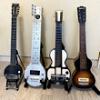
1935 A22 Rickenbacher Frypan (C6), 1937 7string Prewar Rickenbacher Bakelite (C Diatonic), 1937 7string Epiphone Electar (Jerry Byrd's E9), 1937 Epiphone Electar (C#m9), 1940's Post War Rickenbacher Bakelite (Feet's D), 1950 Supro (Open F), 1950's Rickenbacher ACE (C6), 1950's Rickenbacher A25 Frypan (A6), 1957 National New Yorker (Jerry's E13), 1955 Q8 Fender Stringmaster (A6, C6, Noel's E13, C Diatonic), 1961 Supro (Open A), 8string VanderDonck Frypan (Buddy Emmons's C6).